

Hirakata, Rosa (AUS)
Shifu Paper Cloth
Highly Commended
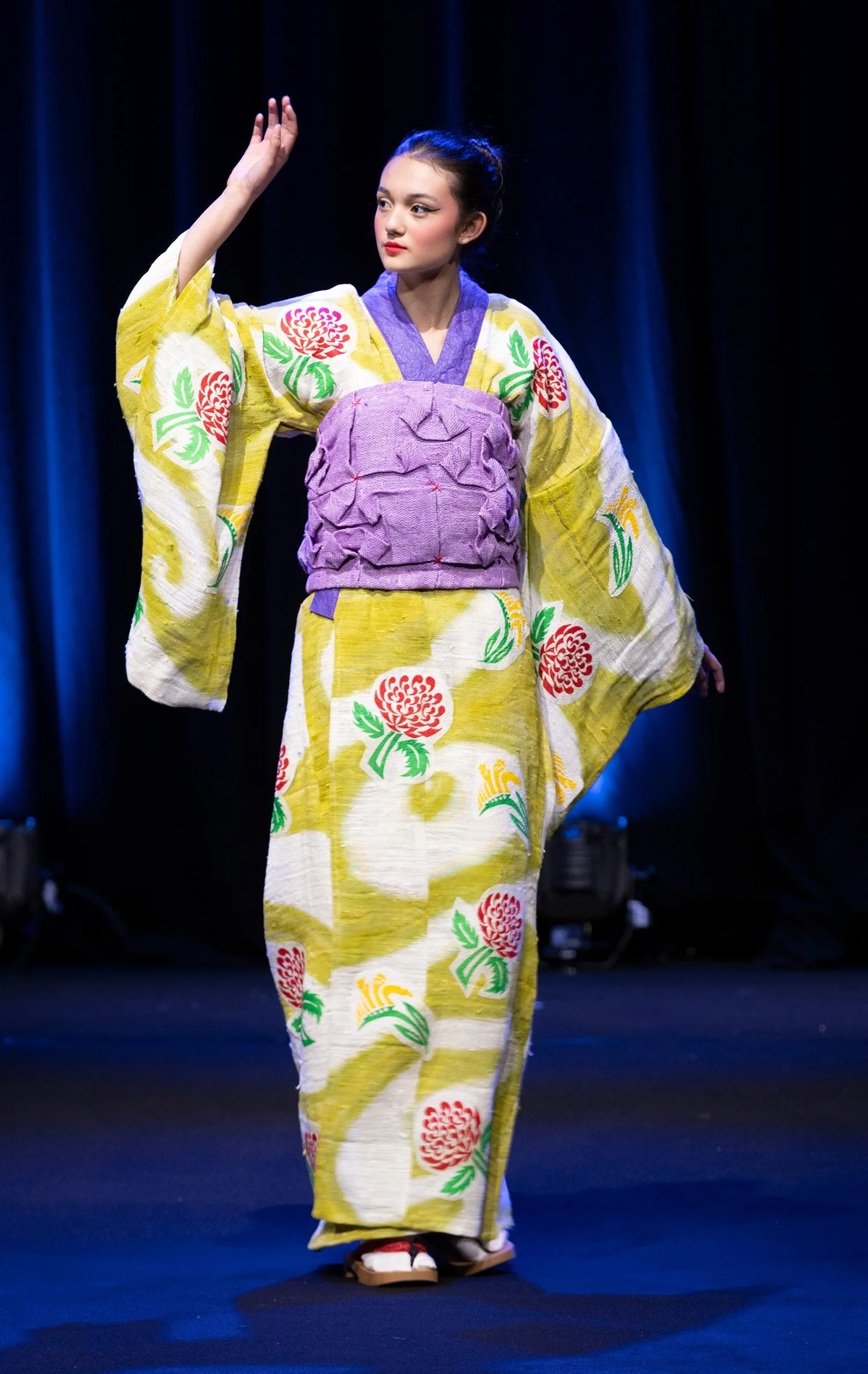
Shifu Paper Cloth is a celebration of Rosa’s Japanese heritage and my home in Australia through the quiet yet striking beauty of the woven paper.
Rosa’s Artist’s Statement provides insights about her love of the craft, and the impact it has on her approach.
“During my 25 years of experience in costume design and making, I have learnt to respect the material I work with; rather than forcing it to do what I want, I work with the material, learn from it, and go with the flow.
I believe this is why making shifu is so appealing to me. You work ‘with’ the material at every stage of the cloth-making from cutting the paper, rolling it, spinning it to make kami-ito (paper thread), to finally weaving the yarn into a cloth … so unique.
The cloth is scattered with tsugime ‘seed’ which are the joints of thread where the paper is cut to make a continuous long thread. The weaver has no control over the size or shape of these ‘seeds’, nor where they will pop-up on the cloth.
The whole process is so tactile and earthy that it gives you a profound sense of calmness, yet it requires you to be very present.”
TECHNIQUE and MATERIALS
Shifu literally means “paper cloth” in Japanese. It is labour intensive as the kozo paper is cut into very thin strips (2mm-10mm), hand rolled and spun into kami-ito (paper thread) before it can be woven into cloth. The entire kimono and the obi belt will be made entirely of shifu.
The warp paper yarn is from PaperPhine in Austria. Weft paper yarn (kami-ito) was made by me, using kozo paper from Awagami Factory. The same kozo paper was used for making the paper panel of the undergarment skirt. The paper was softened, textured and reinforced using momigami technique.
Shibori (tie-dye) techniques were used for for dyeing the cloth.
Katazome (resist paste dyeing technique) was used for painting Australian native flowers (waratah & kangaroo paws)
Yarn dyeing kami-ito before it is woven into shifu
Shadowfolds to create 3D textures on the obi
Momigami technique has also been applied to the flower applique. The flowers were screen-printed onto kozo paper.
The green background was hand-painted. The blank swirling areas were left untouched, to be able to appreciate the uniqueness of the cloth.
The weft yarns of the Obi were hand-dyed before they were woven. Shadowfold technique, developed by Chris K. Palmer, was used to create the 3D geometrical patterns.
See the Work on Film
Photos Credit: Grant Wells Photo